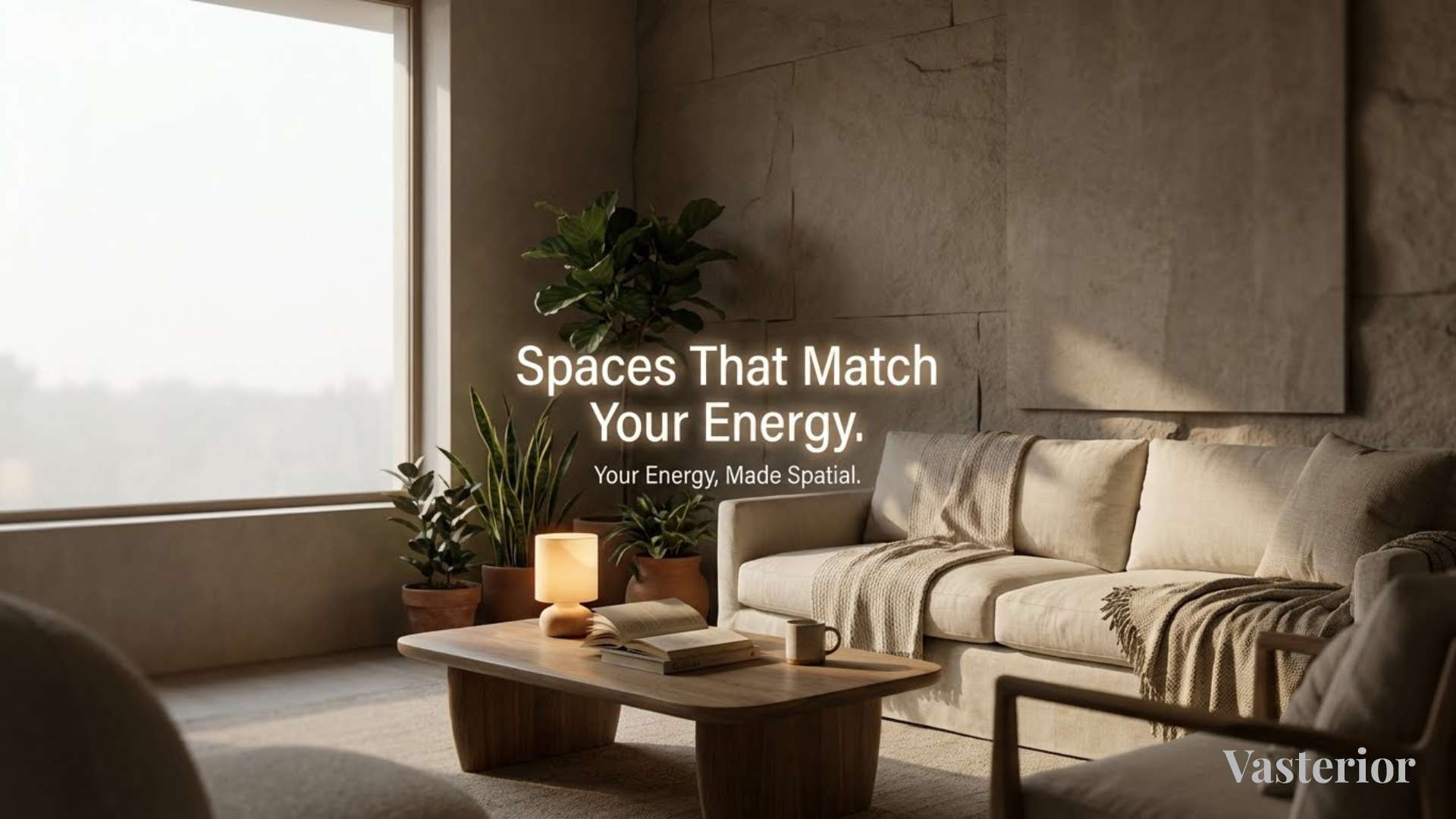
Vasterior believes a home is not just a physical space—it's an extension of the person living inside it.
As we move into 2026–27, interior design is undergoing a quiet but powerful shift. Homes are no longer created to impress visitors or follow trends pulled off social media. They're being designed to support energy, routines, ambitions, and emotional well-being.
In short, homes are becoming energy signatures.
From "Looks Good" to "Feels Right"
For years, interior design revolved around aesthetics:
- Matching color palettes
- Statement furniture
- Pinterest-perfect layouts
But today's homeowners are asking a deeper question: "Does my home actually support the way I live?"
In 2026–27, the most valued homes won't be the loudest or the most luxurious. They'll be the ones that feel intuitive—spaces that calm you, energize you, or ground you exactly when needed.
This is where interiors move beyond styling and into alignment.
What Does "Energy Signature" Mean in Interior Design?
An energy signature is the invisible emotional and psychological tone of a space.
It's how:
- A room makes you feel the moment you enter
- Your focus shifts during the day
- Your nervous system relaxes in the evening
- Your mornings either rush you or support you
Two homes can look similar on the surface, but feel completely different to live in.
That difference comes from how thoughtfully the space is aligned with the person, not just the plan.
Design Starts Before Floor Plans Now
In future-ready interior design, execution begins after understanding the resident.
At Vasterior, this phase is often overlooked, but it's the most important one.
Before layouts, finishes, or furniture, modern design now considers:
- Daily routines and lifestyle patterns
- Mental workload and stress levels
- Introvert vs extrovert energy
- Whether the home is meant to energize, stabilize, or restore
A founder working 14-hour days needs a different spatial rhythm than a family raising young children. A creative professional needs stimulation without chaos. A retired couple needs emotional grounding more than visual drama.
Design that ignores this becomes decorative. Design that honors this becomes transformative.
How Layout, Light, and Materials Shape Daily Life
Every design decision quietly influences how life flows inside a home.
Layout & Movement
Open layouts are no longer default "luxury." They're chosen intentionally, only when mental openness is needed.
Contained spaces are no longer seen as restrictive. They're used to create focus, emotional safety, and grounding.
Natural Light & Direction
Light isn't just about brightness anymore—it's about timing.
- Soft morning light for calm starts
- Balanced daylight for productivity
- Controlled evening lighting for nervous system reset
Materials & Texture
In 2026–27 interiors:
- Natural materials are chosen for emotional grounding
- Overly reflective, harsh finishes are used sparingly
- Texture becomes more important than shine
This is where design meets human biology.
Interiors Based on Profession, Mindset, and Goals
The era of one-size-fits-all homes is officially over.
Modern interiors are increasingly personalized around how people think and work.
Examples:
- Entrepreneurs & business owners need clarity, grounding, and decision-friendly spaces
- Remote professionals need focus zones without isolation
- Creative thinkers need inspiration that doesn't overwhelm
- Families prioritize emotional balance over visual excess
When interiors align with mindset, productivity improves, stress reduces, and the home starts working with you, not against you.
The Quiet Intelligence of Vastu in Modern Homes
In 2026–27, Vastu is no longer treated as a checklist or superstition.
It functions as background intelligence.
Modern Vastu integration focuses on:
- Spatial flow
- Natural energy movement
- Orientation-based decisions
- Balance rather than rigid rules
At Vasterior, Vastu doesn't dictate design—it guides it.
It quietly informs room placement, functional zoning, and energy balance within layouts.
When applied thoughtfully, it enhances modern living without being visually or emotionally heavy.
Why Aligned Homes Age Better Than Trendy Ones
Trends fade. Alignment lasts.
Homes designed around personal energy:
- Feel relevant for longer
- Need fewer redesigns
- Support life transitions better
Whether it's career shifts, family growth, or lifestyle changes, an aligned home adapts instead of resisting.
This is why 2026–27 interiors are less about "what's new" and more about "what fits."
Where Vasterior Fits Into This New Way of Living
Vasterior doesn't design homes from catalogues.
It designs them from conversations, observations, and deep understanding.
The process focuses on:
- Designing from the inside out
- Aligning space with lifestyle and intention
- Balancing modern aesthetics with spatial wisdom
- Creating homes that feel calm, purposeful, and personal
The goal isn't to impress visitors. It's to support the people who live there, every single day.
The Future of Luxury Is Alignment
In the coming years, luxury won't be defined by excess.
It will be defined by:
- How well a home understands you
- How naturally it supports your rhythm
- How quietly it improves your quality of life
Homes are no longer just places where life happens. They shape how life feels.
And in 2026–27, the most powerful homes won't announce themselves loudly—they'll simply feel right.
Thinking about a home that actually supports your lifestyle, not just your layout?
That's where intentional design begins.